Kilims: The Art of Flatwoven Rugs
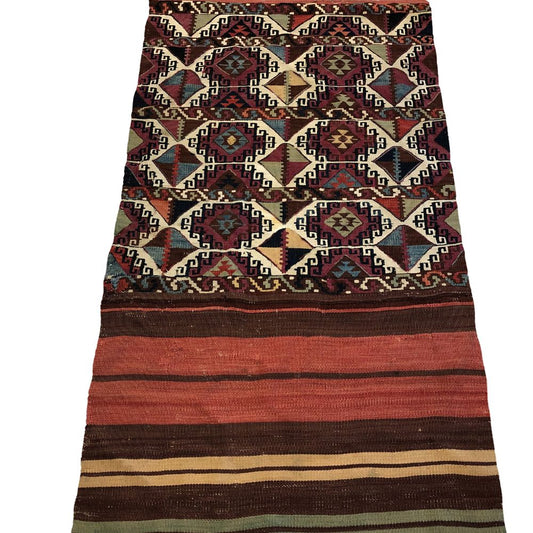
Beyond the realm of knotted pile rugs lies an equally rich and ancient weaving tradition in artistry: the kilim. These flatwoven rugs represent a fundamentally different approach to floor covering.
Woven rather than knotted, reversible rather than one-sided, lighter rather than heavy, yet equally durable and often more versatile.
The Persian kilim and its counterparts across weaving regions combine bold tribal design with practical flexibility, creating textiles that function as rugs, wall hangings, throws, or layering pieces.
Our collection spans Persian, Turkish, Caucasian, and Afghan origins, ranging from antique to semi-antique eras, all sourced from Canadian estates where their flatweave durability and versatile beauty have been proven in good condition across generations.
Kilims have flatwoven rug construction.
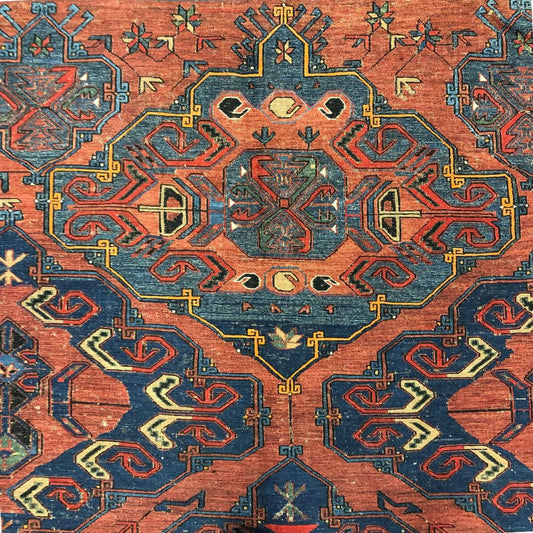
What distinguishes kilims is their flatweave construction. Unlike pile rugs, where individual knots create texture and depth, kilims employ the slit-weave technique, in which weft threads interlock to create a pattern without a pile. Or Soumak's supplementary weft brocading that adds textural complexity to flatweave foundations.
This construction creates Kilim rugs fundamentally different from pile rugs: lighter in weight, making them easier to transport and layer. Reversible, offering design flexibility since both sides display the pattern. More pliable, it drapes naturally over furniture or hangs on walls.
Our collection showcases this technical diversity, from traditional slit-weave kilims to richly textured soumak pieces.
Kilim rugs have regional diversity.
Regional diversity defines the character of the collection. Persian kilims from Senneh demonstrate refined city flatweave precision. Qashqai pieces bring bold tribal Southwest Persian design. Kurdish kilims showcase geometric power characteristic of mountain weaving. Turkish Anatolian kilims contribute distinctive motifs and colour traditions developed across centuries of village weaving.
Caucasian kilims add their characteristic angular geometries and vibrant palettes. Afghan kilims round out the collection with tribal directness and earthy authenticity.
This geographic range means that our estate collection encompasses multiple weaving traditions, each with a distinct design vocabulary and its own cultural heritage.
Complete Design Repertoire
Design diversity encompasses the entire repertoire of flatwoven rugs. Bold geometric patterns demonstrate tribal confidence.
Diamonds, zigzags, and medallions are rendered with angular precision that complements the flatweave technique.
Tribal medallions anchor compositions with symbolic power. Prayer rug formats with mihrab arches transform devotional textiles into a form of spiritual artistry.
Striped and banded designs showcase colour mastery through simple compositional structure. Abstract tribal patterns push geometric vocabulary toward a modern sensibility, creating pieces that are equally at home in traditional or contemporary settings.
Kilims have a diverse colour tradition.
Colour diversity reflects multiple regional traditions. Bold, vibrant tribal colours celebrate chromatic abundance. Saturated reds, deep blues, and brilliant oranges create visual impact. Earth tones and natural dyes demonstrate organic palette subtlety. Vegetable-dyed warmth in rust, gold, brown, and green connects textiles to the landscape.
Rich jewel tones add depth and luxury across different origins. This chromatic range offers options for any aesthetic vision.
Era diversity and flatwoven rug durability,
Era diversity, from antique to semi-antique, provides collectors with access to different periods of flatweave excellence. Each reflects evolving tribal traditions while maintaining the core integrity of weaving.
Estate provenance validates flatweave durability. These kilims emerged from Canadian collections where they served diverse functions. Floor coverings, furniture throws, and wall hangings, across decades. Their good condition proves that flatweave construction can survive real use despite lacking pile protection.
A kilim has versatile beauty,
Kilim rugs offer versatile beauty. Lighter, reversible, endlessly adaptable. These estate pieces await spaces where flexibility matters as much as artistry.